Some research on factors that affect energy.
Sleep Deprivation Bad, Short Naps good
- Killgore 2010 (Sleep Deprivation Mega Review)
- Reaction Time and Attention
- Sleep deprivation has strong detrimental effects on response time, which stacks as sleep debt accumulates. "restricting sleep by only a couple of hours per night (e.g. 6 h per night) can lead to significant slowing of response times that, if prolonged for up 2 weeks, can reach impairment levels that are comparable to about two nights of total sleep deprivation (Van Dongen et al., 2003)"
- Ability to pay attention drops more quickly. People already get worse at maintaining vigilance as time goes on, but sleep deprivation makes this worse and faster-acting (10m of the Psychomotor Vigilance Task is long enough for sleep-deprived people to show a drop in performance, but not for normal sleep individuals).
- These effects are stronger when your sleep drive is stronger. Since sleep drive varies strongly with circadian rhythm throughout the day, you get a double whammy in the morning and late at night.
- Emotions
- ...lots of other interesting effects. Surprisingly the higher-level you go the effects seem more mixed/less conclusively bad.
- Reaction Time and Attention
- Lovato et. al. 2010 (Review on Effect of Naps)
- Naps are common. Proportion of individuals surveyed ranged from 34%-84% depending on the country.
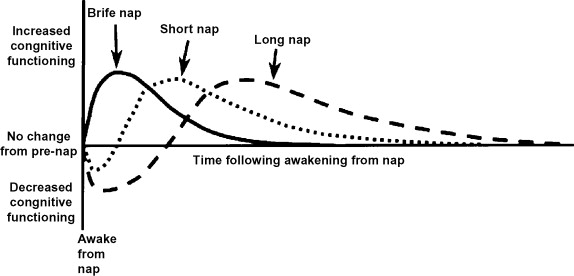
- Naps of all lengths improve cognition eventually, but naps >30m hurt it first. See the accompanying (seemingly purely explanatory) figure:
- Patrick et. al. 2017
- Setup: randomized study of N=64 college students assigned to single night of {normal, no} sleep -> point measurement of reaction time, working memory (as measured by Simon), executive function (as measured by Stroop test)
- all tests between 9am-1pm, though "all follow-up testing aimed to take place within 1 h of initial session time"
- Note on cognitive tests: Stroop / Simon seem pretty standard, and I do buy that they induce mental effort.
- Results: found significant increase in reaction time, but no cognitive effects
- Thoughts: Somewhat surprising, though perhaps that all tests were completed within an hour and perhaps in the early morning means students were able to muscle through. Interested in if there would be negative effects on Stroop Test / Simon Performance
- Setup: randomized study of N=64 college students assigned to single night of {normal, no} sleep -> point measurement of reaction time, working memory (as measured by Simon), executive function (as measured by Stroop test)
- Further reading:
Circadian Rhythm
-
prior
- I heard that 3pm is the low point for most people (and point of most traffic accidents, presumably causally related). How substantial is this effect? Are the cycles the same across people? Regulated by the sun? How strong is the effect of digestion (post-lunch)?
-
Czeisler and Gooley 2007 (review)
- Energy/temperature fluctuates in a roughly 24h cycle. Initially studied among 2 subjects that were shielded from all daylight in Mammoth Cave and working in a 28h cycle; body temperature was still found to fluctuate in a 24h period.
- The Setting of our Circadian Rhythm happens via exposure to light. People used to think that humans had transcended the need for such a stimulus and instead our Circadian Rhythms were set by social interaction. Neat.
- Interestingly, while the setting effect is stronger with a longer exposure or an exposure to brighter light, exposure to normal indoor light (100 lux) has half the effect as light 100x brighter.
- Many bits of our Circadian Rhythm are shared with other organisms, even insects.
Goel et. al. 2014
Do breaks improve focus?
- prior
- Anecdotally short breaks (<10m) feel very useful in maintaining my focus for hours at a time without breaking me out of the flow.
How much do people associate an area with focus/distraction?
- prior
- have heard that we unconsciously associate physical spaces with mental states (ex. CGP Gray in this video), would love to see some science on this.
- How much of this is beyond the effect of an environment having cues for habits (ex. seeing your phone -> scrolling social media, smokers/drug users returning to their environment and relapsing)
- data points
Things I'd like to look at in the future
- More on Sleep
- I've heard about stuff like sleep debt as a moving average and reduced ability to notice sleep deprivation after a point, which I'd like to understand further. And saw several results that gave conflicting answers as to whether sleep impairs higher-level cognitive faculties, which I should explore in depth at some point.
- Mood <-> Energy
- Much of the time when I'm in a bad mood it seems at least partially due to being low energy. Conversely, it feels like being in a good mood makes me feel like I'm more energetic.
- exercise <-> energy
- anecdotally, I'm often more energetic post-exercise. Dunno how much of this is the uptick in mood. Also the physical fatigue sometimes hurts mental energy, so how to reconcile that?
- plenty of psych experiments that show people exert themselves less after any sort of willpower exertion - though remember this being somewhat controversial ("willpower as a central resource that gets depleted" vs. "...")
- anecdotally, I'm often more energetic post-exercise. Dunno how much of this is the uptick in mood. Also the physical fatigue sometimes hurts mental energy, so how to reconcile that?